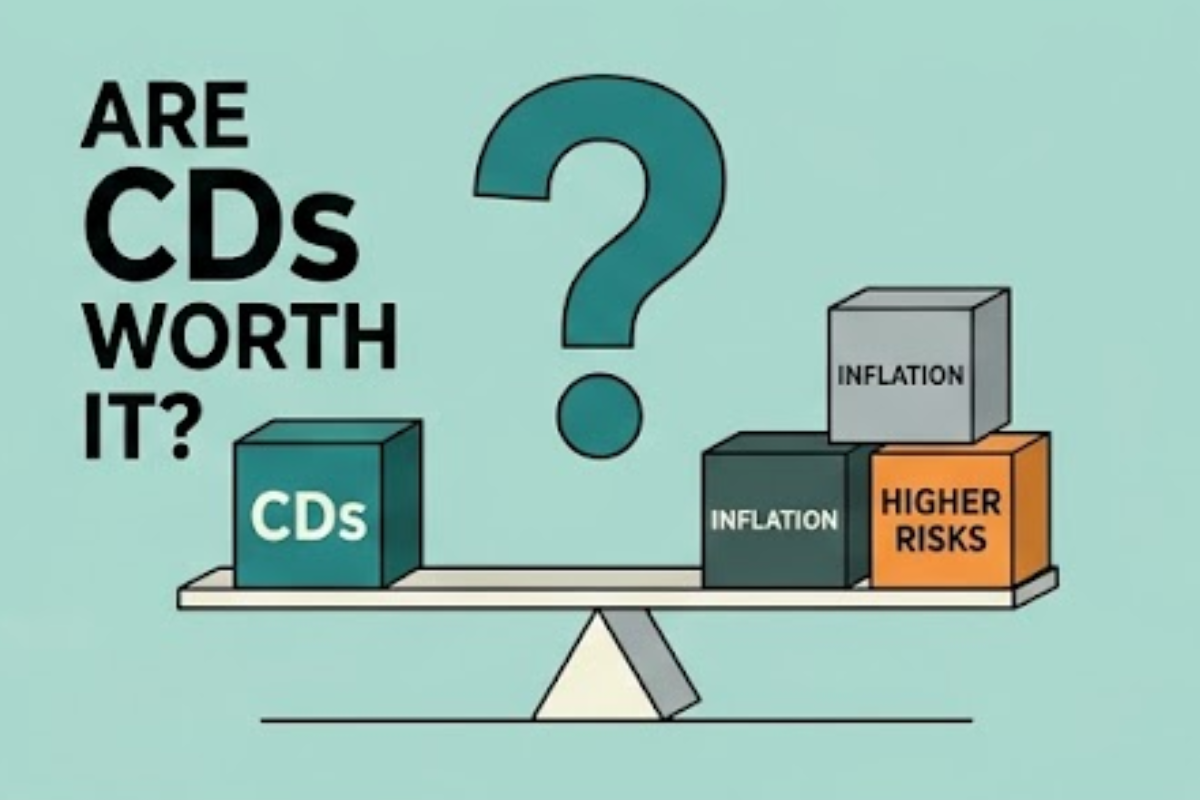
Certificates of Deposit, commonly called CDs, can be an appealing option for savers who want predictable returns without taking on the volatility associated with stocks or many other investments. A CD generally pays a fixed interest rate in exchange for keeping money deposited for a set period, such as six months, one year, or several years.
But are CDs worth it right now? The answer depends on how soon the money may be needed, the rate available, and whether locking in a fixed return fits the broader financial plan.
With many competitive CDs currently offering yields above traditional savings accounts, they may be useful for conservative savers. However, the best choice is not always the CD with the highest advertised annual percentage yield, or APY.
Why CDs may be attractive right now
One of the main benefits of a CD is certainty. When a fixed-rate CD is opened, the interest rate is generally locked in for the entire term. This makes it easier to estimate how much the deposit could earn by maturity.
Recent market data shows that some competitive CDs are offering APYs above 4%, with certain short-term products paying more than many longer-term options. At the same time, the national average rate can be much lower, making it important to compare institutions rather than automatically accepting the rate offered by a primary bank.
CDs may be especially useful for people who:
- Want to protect their principal
- Prefer predictable interest earnings
- Have money that will not be needed immediately
- Want to avoid stock-market volatility
- Are saving for a planned expense with a known timeline
For example, someone planning to make a major purchase in 12 months may prefer a one-year CD over placing the money in the stock market. A market decline shortly before the money is needed could reduce the available balance, while a CD generally provides a more predictable outcome.
Safety is another important advantage
CDs held at an FDIC-insured bank are generally covered by federal deposit insurance, subject to applicable ownership categories and coverage limits. FDIC insurance covers several types of bank deposits, including checking accounts, savings accounts, money market deposit accounts, and CDs.
This makes CDs different from stocks, mutual funds, and other market-based investments. A CD’s value does not normally rise and fall with daily market movements.
However, deposit insurance does not eliminate every consideration. Savers should confirm that the financial institution is insured and understand how their balances are treated across accounts and ownership categories. People with large deposits may need to review their total balances at a bank rather than considering each account separately.
The main drawback: limited access to money
The biggest disadvantage of a traditional CD is that the money is generally intended to remain deposited until maturity. Withdrawing funds early may result in an early-withdrawal penalty.
The penalty varies by bank and CD term. It may involve losing a certain number of months of interest, and in some cases, the cost can reduce part of the original deposit.
This means CDs may not be suitable for emergency savings. Money set aside for unexpected medical bills, home repairs, job changes, or other urgent expenses may be better kept in a liquid savings account.
Before opening a CD, it is important to ask:
Could this money be needed before the CD matures?
If the answer is uncertain, a high-yield savings account may provide more flexibility.
CDs versus high-yield savings accounts
High-yield savings accounts can sometimes offer rates close to those available on short-term CDs. Some competitive savings accounts have recently offered APYs around or above 4%, although rates can change over time.
The major difference is that a savings account usually has a variable interest rate. The bank can raise or lower the rate, while a fixed-rate CD generally preserves its stated APY through maturity.
A CD may make sense when a saver wants to lock in a known return. A high-yield savings account may be more suitable when easy access to funds is a priority.
Should savers choose short-term or long-term CDs?
The current rate environment makes this decision more complicated. In some cases, short-term CDs are paying more than longer-term products. That means committing money for several years may not always result in a higher return.
A short-term CD may be useful for people who want flexibility. When it matures, the money can be reinvested at the rates available at that time.
A longer-term CD may appeal to someone who expects rates to decline and wants to preserve today’s yield for several years. However, if rates rise later, money locked into a long-term CD could earn less than newly available products.
One way to manage this uncertainty is through a CD ladder. Instead of placing all the money into one CD, a saver divides it among several CDs with different maturity dates. As each CD matures, the funds can be used or reinvested.
The bottom line
CDs can be worth considering right now for people who value predictable returns, principal protection, and a fixed rate. They may be particularly useful for money connected to a future goal with a clear timeline.
However, CDs are not automatically the best place for every dollar. Emergency funds may require greater flexibility, and long-term growth goals may call for investments with more potential return and more risk.
Before opening a CD, compare APYs, minimum deposit requirements, early-withdrawal penalties, maturity dates, and insurance coverage. A competitive CD can be a practical part of a savings strategy, but the right choice depends on how the money will be used and how long it can remain untouched.