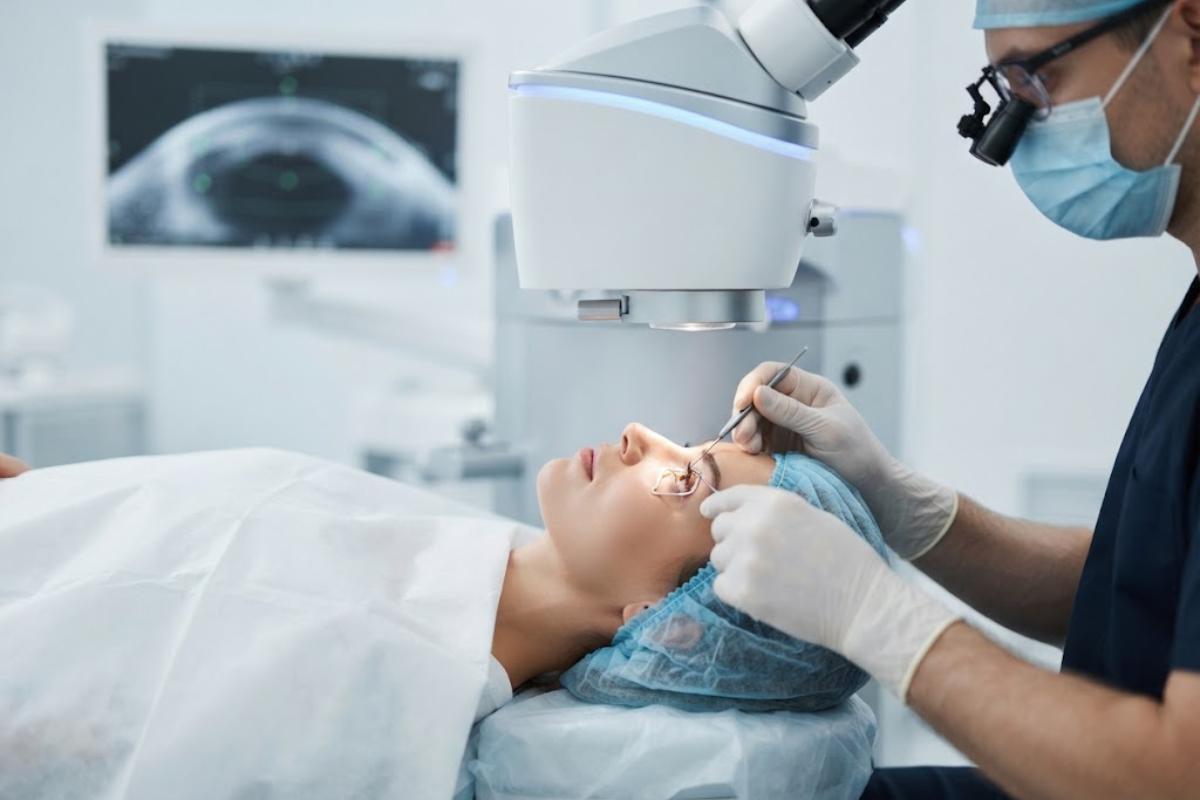
LASIK can provide clear distance vision for people who want less dependence on glasses or contacts. But having the procedure after 40 comes with a different consideration: your eyes continue to age even after the cornea has been reshaped. The biggest change usually involves presbyopia, the gradual loss of the eye’s ability to focus on nearby objects.
1. Reading vision can change even after successful LASIK
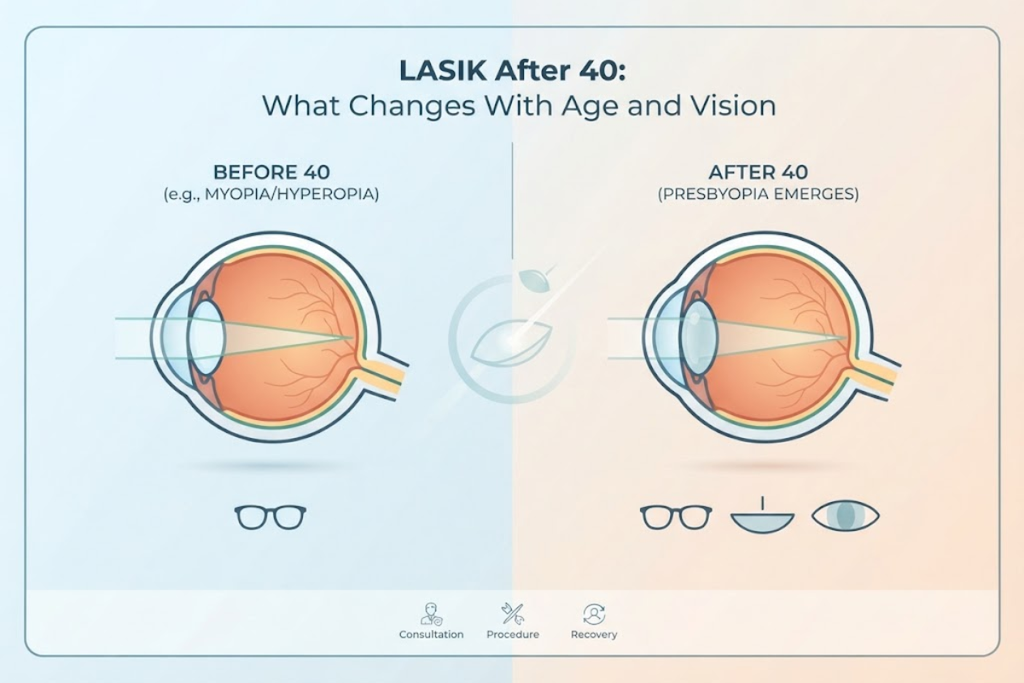
LASIK reshapes the cornea to correct problems such as nearsightedness, farsightedness and astigmatism. It does not stop the natural aging of the lens inside the eye.
After about age 40, the lens gradually becomes less flexible. That makes it harder to shift focus from distant objects to something close, such as a phone or book. This condition, known as presbyopia, commonly becomes noticeable during the 40s and continues progressing into later decades.
That means someone can have excellent distance vision after LASIK and still eventually need reading glasses.
2. LASIK may change how you experience presbyopia
There can be an interesting difference between someone who has always been nearsighted and someone who corrects nearsightedness with LASIK.
A person with untreated myopia may sometimes remove their glasses to read comfortably as presbyopia develops. After LASIK corrects the nearsightedness, that natural advantage disappears because both eyes now focus more effectively at distance.
As a result, a former glasses wearer may find that reading glasses become necessary later in life. Mayo Clinic notes that people who have their nearsightedness corrected with LASIK will likely need reading glasses eventually as presbyopia develops.
3. Monovision can be an option
Some people over 40 consider monovision LASIK. Rather than correcting both eyes identically, the surgeon corrects one eye primarily for distance and leaves the other slightly nearsighted for closer work.
The brain then learns to use each eye for different viewing distances. The approach can reduce dependence on reading glasses, although it does not suit everyone.
One potential tradeoff involves depth perception or certain aspects of visual quality. Because of that, an eye doctor may recommend trying monovision with contact lenses before making a permanent surgical decision.
4. Your LASIK evaluation becomes more important
Being over 40 does not automatically rule out LASIK. However, the evaluation needs to consider more than your glasses prescription.
An eye specialist will look at factors such as corneal thickness and shape, tear-film health, eye pressure and the overall condition of the eyes. Existing problems such as significant dry eye, certain corneal conditions, glaucoma or cataracts can affect whether laser surgery makes sense.
The goal isn’t simply to determine whether a laser can correct your current prescription. Your doctor also needs to consider how your vision may change with age.
5. Near vision may require more correction over time
Presbyopia generally progresses rather than appearing once and staying at the same level. You might initially notice difficulty reading small print, holding your phone farther away or needing brighter light for close-up tasks.
Reading glasses may be enough for many people. Others may use progressive lenses, contact lenses or discuss surgical approaches designed to address near vision.
Even procedures intended to reduce dependence on glasses don’t necessarily guarantee that you’ll never use readers again.
6. LASIK after 50 can involve different considerations
By the 50s and 60s, doctors may pay closer attention to age-related changes inside the eye. Cataracts, for example, can affect vision and may eventually make a different type of eye surgery more appropriate than corneal laser surgery.
This doesn’t mean LASIK suddenly becomes unsuitable at a particular birthday. Rather, the condition of the eyes matters more than age alone. EyeWiki notes that people over 60 may be better candidates for intraocular refractive procedures in some circumstances.
7. The best question isn’t simply whether LASIK works after 40
For someone considering LASIK in their 40s, the more useful question involves what type of vision they want for the next several years.
If clear distance vision without glasses matters most, conventional LASIK may remain an option when the eyes qualify. If reducing the need for reading glasses matters just as much, monovision or other approaches may deserve discussion.
LASIK can correct the cornea, but it cannot stop the natural aging process of the eye’s lens. Understanding that distinction before surgery can make the eventual result much easier to live with.