Inflation and investments are closely connected because rising prices can reduce the purchasing power of your returns. The number on your investment account may increase while its real-world value barely moves. That difference matters when you are saving for retirement, building wealth, or simply trying to keep your money ahead of rising living costs.
Inflation measures how the prices of goods and services change over time. A useful starting point for understanding the topic is inflation, which explains why the same amount of money can buy less in the future than it does today.
Inflation and investments: nominal vs. real returns
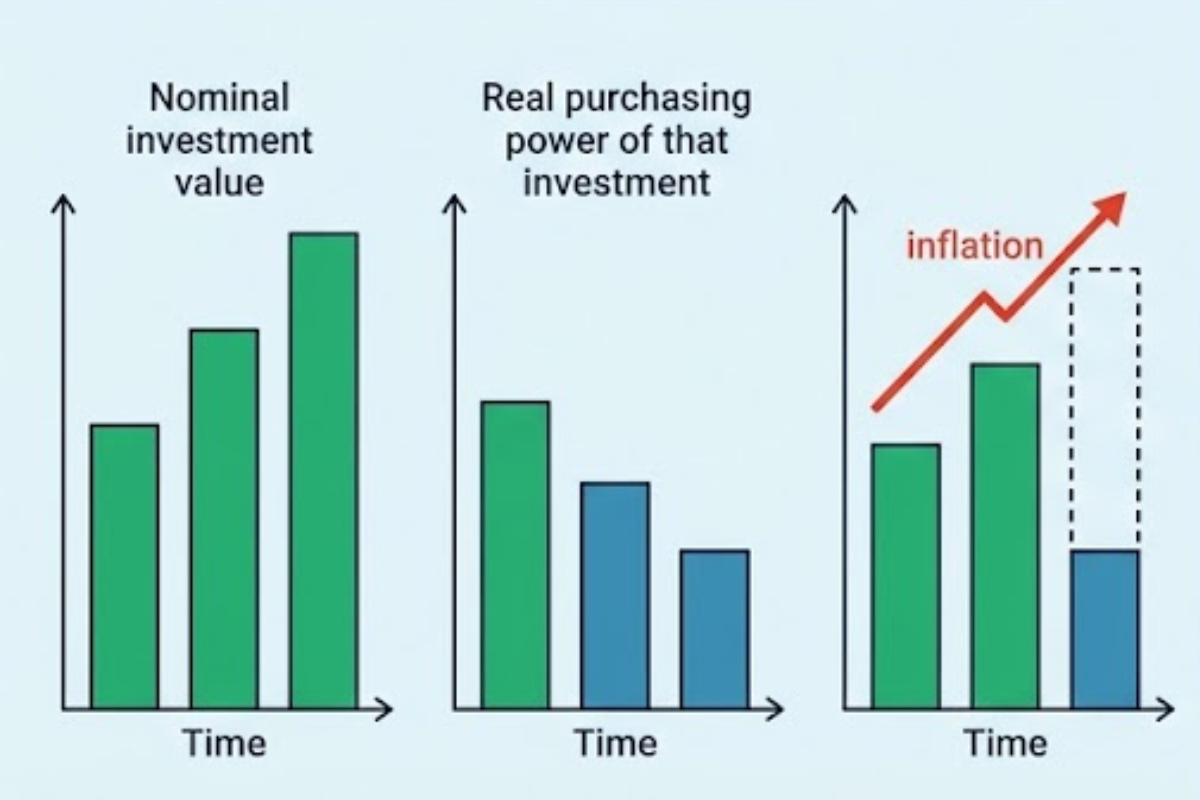
Suppose you invest $10,000 and earn 7% over a year. Your account would grow to $10,700.
That sounds like a 7% gain, but what if inflation during that period reached 4%?
Your investment gained 7% in nominal terms, while your purchasing power increased by roughly 3% after accounting for inflation.
A simple way to think about it:
Real return ≈ investment return − inflation
The exact calculation uses compounding, but the basic idea remains the same. If your investments grow more slowly than prices, your money loses purchasing power even though your account balance may be increasing.
Cash can quietly lose purchasing power
Money sitting in a checking account generally doesn’t grow enough to keep pace with inflation. The same $10,000 could buy considerably less several years from now if prices continue rising.
Savings accounts and certificates of deposit can provide interest income, but the rate you earn needs to be compared with inflation.
For example, if your savings account earns 3% while inflation runs at 4%, your nominal balance rises, but your purchasing power falls.
This doesn’t mean keeping cash has no purpose. Emergency funds and money needed for near-term expenses have different goals from long-term investments. The issue comes when large amounts of long-term savings remain in low-interest accounts for many years.
Stocks can provide some protection over long periods
Stocks don’t automatically beat inflation every year. Markets can fall sharply during periods when prices are rising.
Over longer periods, though, businesses can raise the prices of their products and services, increase revenue, and potentially grow earnings. Companies with strong financial positions may have more room to deal with higher wages, materials, transportation and other operating costs.
That can make stocks useful for investors with long time horizons.
Still, inflation doesn’t affect every company in the same way. A business with high costs and limited ability to raise prices could face more pressure than a company with strong pricing power.
Bonds can react differently
Inflation can create a particular problem for traditional fixed-rate bonds.
Imagine buying a bond that pays 4% annually. If inflation later rises to 6%, those fixed payments have less purchasing power.
Rising interest rates can also push the market value of existing bonds lower. New bonds may begin offering higher yields, making older bonds with lower rates less attractive.
The impact depends on factors such as maturity, interest rate, credit quality and the type of bond.
Treasury Inflation-Protected Securities, commonly called TIPS, work differently. Their principal adjusts with changes in the Consumer Price Index, providing a direct link to inflation.
Real estate can behave differently too
Real estate can sometimes provide a partial hedge against inflation. Property values and rents may rise as construction costs, labor expenses and other prices increase.
But real estate isn’t guaranteed to rise at the same pace as inflation. Ownership costs also include property taxes that affect the real cost of a home. Higher mortgage rates can reduce demand, while local economic conditions can affect property values.
For investors who don’t want to own physical property, real estate investment trusts, or REITs, provide another way to gain exposure to the sector. Buyers considering direct ownership should also understand the realities of putting 20% down.
Inflation matters even more for retirement
Inflation can become particularly noticeable during retirement because spending may continue for decades.
Consider someone who spends $50,000 a year today. At an average inflation rate of 3%, that same lifestyle could require roughly $67,000 annually after 10 years.
After 20 years, the figure could approach $90,000.
That doesn’t mean every expense will rise at exactly 3%. Healthcare, housing, food and other costs can move at different rates. The calculation simply shows why a retirement portfolio needs to account for rising expenses rather than focusing only on today’s dollar amount.
Diversification can help
There isn’t one investment that consistently performs best during every inflationary period. That’s why many investors spread money across different asset classes rather than relying on a single source of growth.
A portfolio might include stocks, bonds, cash and other assets depending on the investor’s goals, time horizon and tolerance for risk.
The goal isn’t necessarily to eliminate the effect of inflation. It’s to build a portfolio with a reasonable chance of growing faster than rising prices over the period when the money will be needed.
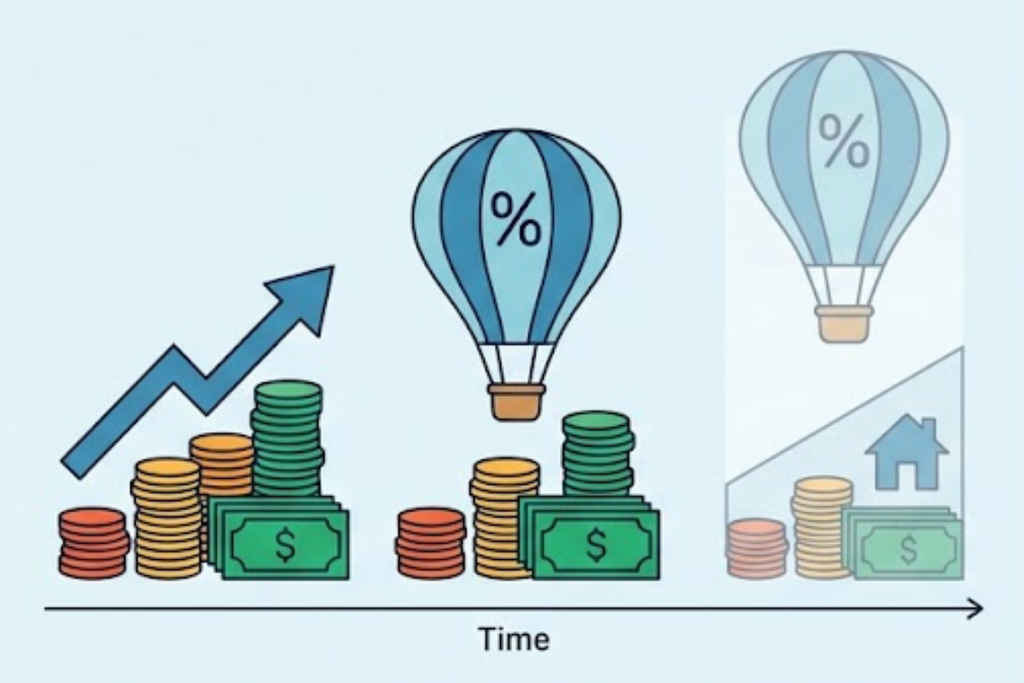
Look at what your money can buy
An investment account showing a higher balance can feel reassuring, but the more useful question is what that balance will actually buy. For property owners, strategic home improvements that increase resale value may also influence long-term returns.
If your portfolio grows 5% while inflation averages 3%, you’ve gained purchasing power. If it grows 2% while inflation averages 4%, the opposite happens.
Inflation turns investing into more than a numbers game. The amount in your account matters, but so does the amount of goods, services and experiences that money can purchase in the future. For long-term investors, understanding inflation and investments together gives a clearer picture of whether wealth is actually growing.